What Is Generative Engine Optimization (GEO)?
GEO means getting your brand named and cited in AI answers. What it is, how it works, what it’s called, and how it differs from SEO and AEO.
In short
- GEO (Generative Engine Optimization) is optimizing to be named in AI answers and cited as a source.
- Google says optimizing for generative AI search is still SEO. Crawlable, indexed pages that answer clearly are the foundation.
- The difference is measurement: besides clicks, you track visibility, position and citation share in AI answers.
Definition
GEO (Generative Engine Optimization) is the work of getting your content shown, represented accurately and cited as a source in the answers of AI assistants like ChatGPT, Gemini, Copilot, Perplexity and Claude.
The term comes from the academic paper of the same name, published in 2023 and presented at KDD 2024.1 The researchers built a way to measure how visible websites are inside generative engine answers, plus a 10,000-query benchmark called GEO-bench.2
How it differs from SEO
Google is clear on this: optimizing for generative AI search is optimizing for the search experience, so it is still SEO.3 There are no additional requirements or special optimizations for AI Overviews and AI Mode; a page needs to be indexed and eligible to be shown with a snippet.4
The difference is the goal and the measurement:
| Aspect | SEO | GEO |
|---|---|---|
| Goal | Top positions and clicks in search results | Being named inside the answer and cited as a source |
| Unit | The page | The answer (and the passage inside it) |
| Measurement | Search Console: clicks, impressions, position | Baseline + Search Console Generative AI report5 + Bing AI Performance6 |
| Competitors | Sites ranking for the same query | Brands named in the answer |
What did the research find?
The paper tested nine methods. The three that worked best:2
- Quotation addition (direct quotes from credible sources)
- Statistics addition (concrete numbers)
- Citing sources (links that back up claims)
These methods produced a relative improvement of roughly 30–40% on the word-count-based visibility measure. In the abstract’s words, GEO can boost visibility by up to 40%.7 Keyword stuffing gave little to no improvement.2
Two important caveats:
- The tests ran on an experimental engine (built on gpt-3.5-turbo) and on Perplexity. ChatGPT, Claude, Gemini and Copilot were not tested separately.2
- Effects vary by domain. Adding statistics worked better for law and opinion questions, for example, while adding quotations worked better for history and explanation questions.2
For a side-by-side comparison, see GEO vs SEO vs AEO.
Common myths
- “If I add llms.txt, AI will recommend me.” Google says Search ignores llms.txt files.3 No major provider has officially said it reads them.
- “I can’t get into AI answers without schema.” Google says structured data is not required.3 Microsoft says schema helps its systems understand content;8 that is not a citation guarantee.
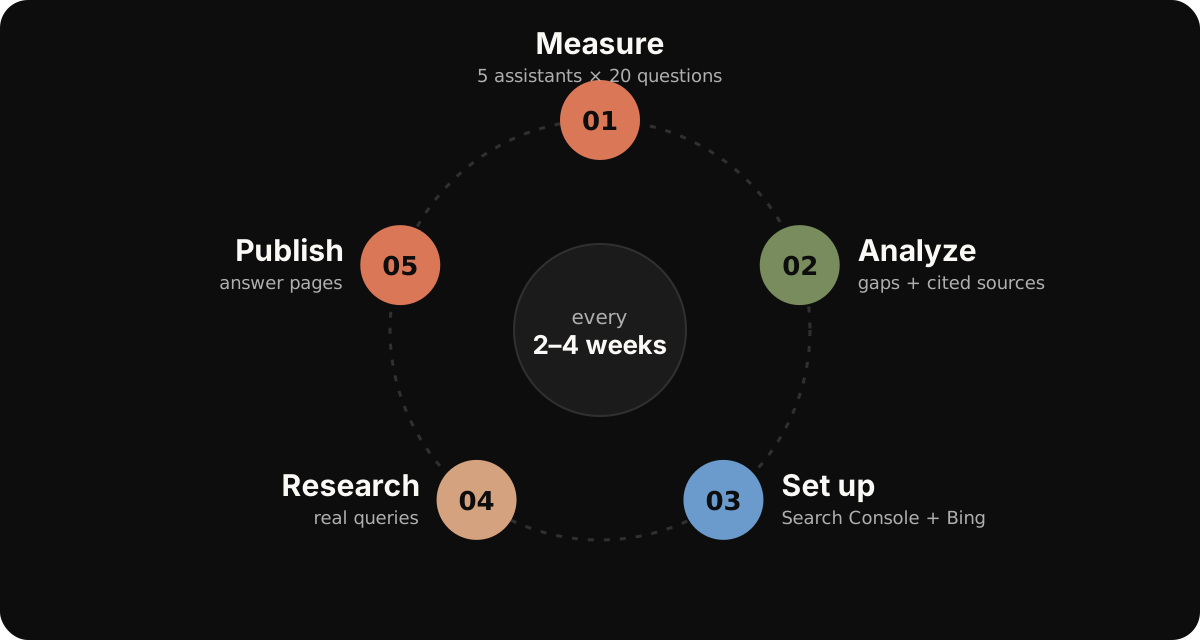
- “GEO is a brand-new discipline.” Its foundation is crawlability, indexing and good content. That is why the first job is setting up Search Console and Bing Webmaster Tools.
Sources
-
Aggarwal et al., GEO: Generative Engine Optimization, KDD ’24, pp. 5–16, DOI: 10.1145/3637528.3671900. ↩
-
Aggarwal et al., GEO: Generative Engine Optimization — full text (v3), Tables 1 and 5. ↩ ↩2 ↩3 ↩4 ↩5
-
Google Search Central, Optimizing your website for generative AI features on Google Search, July 10, 2026. ↩ ↩2 ↩3
-
Google Search Central, AI features and your website, December 10, 2025. ↩
-
Google Search Central Blog, Search Generative AI performance reports in Search Console, June 3, 2026. ↩
-
Bing Webmaster Blog, Introducing AI Performance in Bing Webmaster Tools, February 10, 2026. ↩
-
Aggarwal et al., GEO: Generative Engine Optimization, arXiv, 2023–2024. ↩
-
Microsoft Advertising Blog, Optimizing Your Content for Inclusion in AI Search Answers, October 8, 2025. ↩
FAQ
Is GEO replacing SEO?
No. Google’s own guide says optimizing for generative AI search is still SEO. Think of GEO as a goal and measurement layer on top of SEO.
Where does the term GEO come from?
From the paper “GEO: Generative Engine Optimization” by Aggarwal and colleagues, published in 2023 and presented at KDD 2024.
What is AI search optimization called?
Most often generative engine optimization (GEO). You will also see answer engine optimization (AEO), AI search optimization (AIO) and LLM optimization (LLMO). They describe the same goal: being named and cited in AI answers.
Is generative engine optimization real?
Yes, in the sense that it is measurable. The KDD 2024 GEO paper measured visibility changes in generative engine answers, and Google and Bing now report AI impressions and citations. What isn’t real is a guaranteed #1 spot.
Is AEO the same as GEO?
In practice they overlap heavily. AEO (Answer Engine Optimization) emphasizes answer engines; GEO emphasizes generative AI answers. The method and the measurement logic are the same.
Let your agent do this.
Give one line to ChatGPT or Claude and let the agent run the method step by step.
Read the GEO Asked method at https://geoasked.com/agent.md and run it for my brand, step by step. Ask me short questions first.